
Guide
The Complete HVAC SEO Guide for 2026
Key Takeaways
- Local SEO is non-negotiable; your customers search for HVAC services with local intent.
- Optimizing your Google Business Profile delivers the fastest visibility gains.
- A seasonal content strategy smooths out lead flow, preventing the feast-or-famine cycle.
- Technical SEO matters: fast site speed, good mobile experience, and schema markup help you rank higher in Google and turn visitors into paying customers.
- Expect measurable results in 3-6 months and market dominance after 12+ months of consistent effort.
- SEO delivers compounding ROI, generating leads that cost far less than paid ads over time.
What Is HVAC SEO?
HVAC SEO is the process of optimizing your heating and cooling company’s online presence to rank higher in search results when potential customers need your services. This guide gives you a complete plan for getting found on Google and wherever people search, covering everything from local search dominance to content that generates leads year-round.
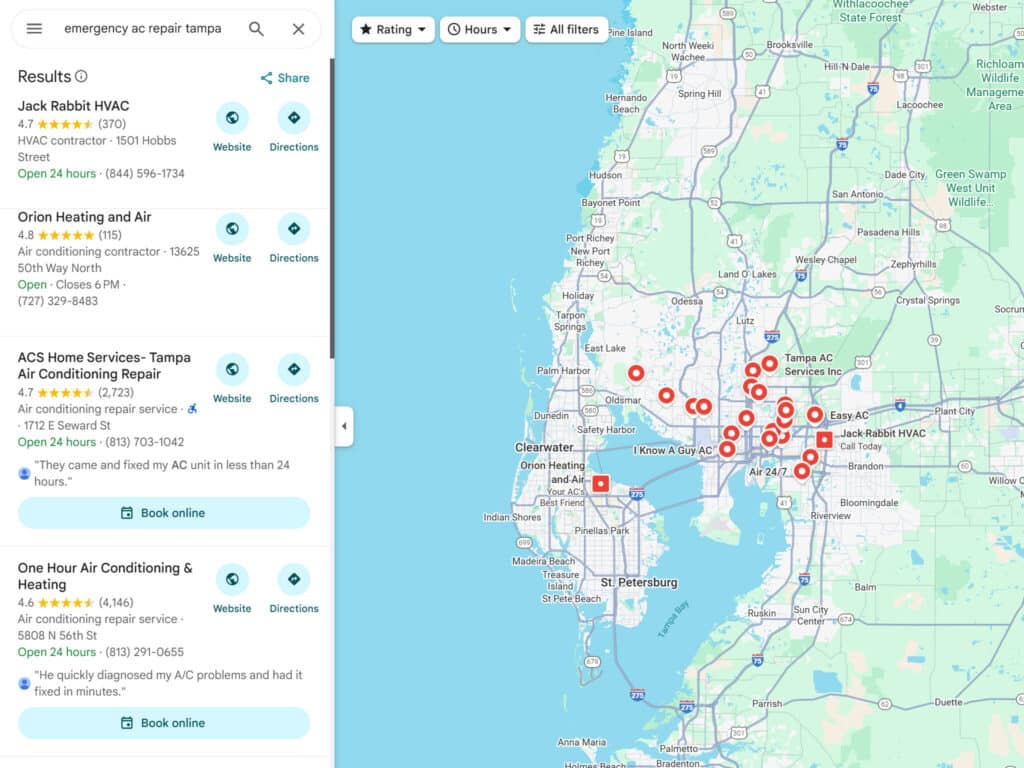
When an air conditioner dies in July or a furnace fails in January, homeowners grab their phones and search. If your business doesn’t appear on the first page—especially in the Google Map Pack—you’re invisible to customers ready to hire immediately. Your competitors who rank well aren’t necessarily better technicians—they’re just easier to find.
This guide delivers specific, actionable tactics for 2026, including seasonal content calendars tailored for the HVAC industry and honest guidance on what you can DIY versus when to hire help. Every strategy here is algorithm-proof, designed to genuinely serve your customers and build real authority.
Why HVAC Companies Need SEO
Your customers are searching online. When someone’s AC breaks in Tampa or their furnace dies in the middle of winter, they’re Googling “emergency AC repair near me.” Search engine optimization puts you directly in front of homeowners who have a problem and are ready to hire, making it the most direct path to ready-to-hire customers.
Industry research shows a single search lead can turn into $10,000+ in lifetime value when you add up the initial repair, ongoing maintenance contracts, future equipment replacements, and referrals. Unlike paid advertising, which stops when you stop paying, SEO compounds over time. Your HVAC SEO strategy builds authority that continues generating low-cost leads for years. Recent data show 96% of consumers use the internet to find local services, and for HVAC, that search often happens during an emergency. Your goal is to get a spot in the Google Map Pack, as the top three local results capture the vast majority of clicks. Appearing there builds trust—customers see organic search rankings as more credible than paid ads.
HVAC Keyword Research
Keyword research finds the exact phrases potential customers type when they need HVAC services. Get this right, and you’re building content that matches real search demand—the cornerstone of any effective SEO strategy. This process is the foundation of your entire SEO strategy, deciding which pages you create, how you structure your website, and your overall SEO strategy timeline.
Types of HVAC Keywords
Your customers search differently depending on what they need. Go after all four types:
- Service Keywords: Direct searches like “furnace installation” and “HVAC maintenance.” These people are ready to hire.
- Problem Keywords: “AC not cooling,” “furnace won’t start,” “weird smell from vents.” When you answer these questions, customers see you know your stuff.
- Brand Keywords: “Carrier HVAC repair” or “Trane furnace service.” Some customers only want specific brands.
- Long-Tail Keywords: Specific phrases like “how much does HVAC repair cost in Tampa” get fewer searches but convert way better.
Tools for Keyword Research
Here’s what to use:
- Google Keyword Planner: Free tool that shows you which keywords people search for and how often.
- Ahrefs/SEMrush: Gives you everything: keyword difficulty, what competitors rank for, and related terms. Worth paying for if you’re serious about this.
- Search Console: Shows which keywords your site already ranks for and where you can improve.
Google Autocomplete: Start typing in Google’s search bar and watch what pops up. That’s what real people are searching.
Prioritizing Keywords
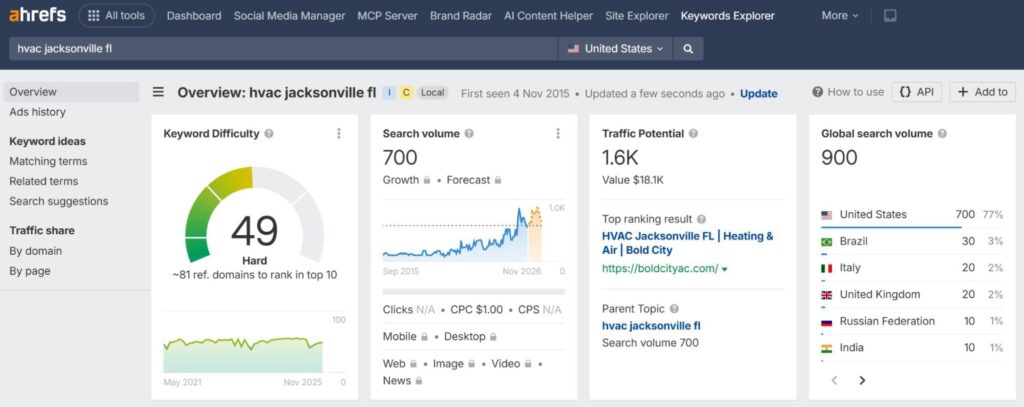
Look for keywords with decent search volume but less competition. High-volume terms get you more traffic, but they’re harder to rank for. Start with easier long-tail keywords for faster wins.
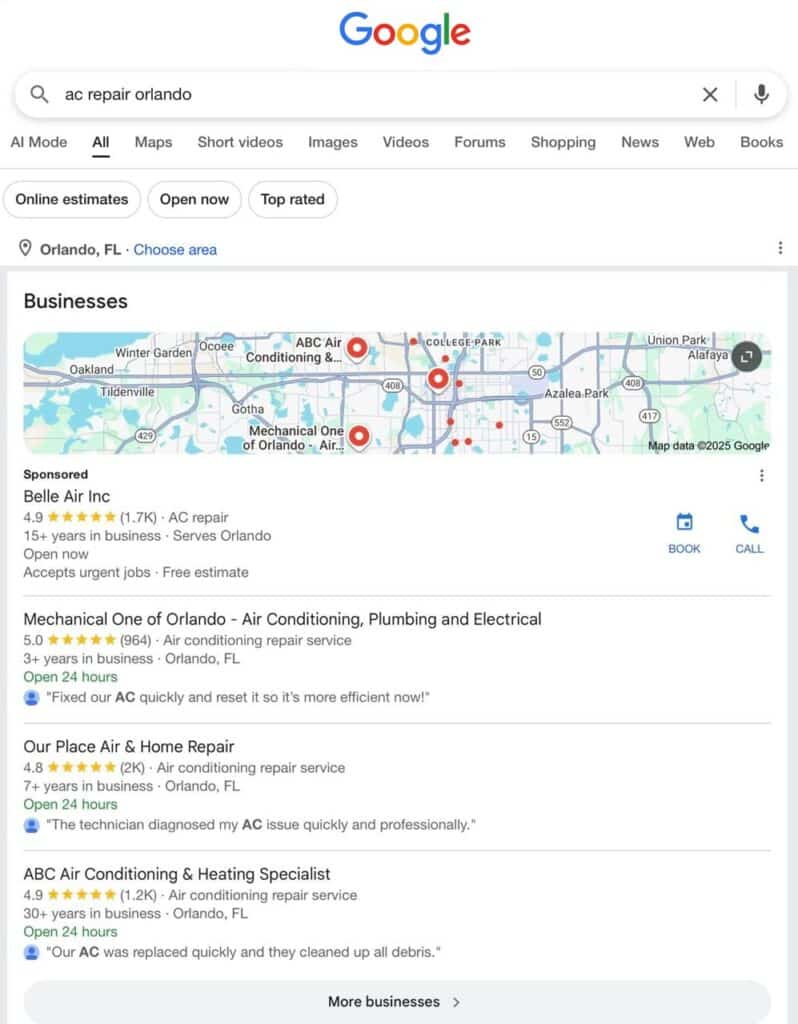
Go after commercial intent first. Someone searching “HVAC maintenance cost” is ready to hire. Someone searching “how does an air conditioner work” is just learning. Big difference. And always add your city. “HVAC repair Tampa” brings you customers who can actually call you today.
Local SEO for HVAC
Local SEO decides whether your HVAC company appears when nearby customers search for services. It focuses on geographic relevance—showing up at the top of search engine results pages in Google’s map pack and location-specific search results. Nearly half of all searches have local intent, and for emergency HVAC services, that number is higher. This is the main way customers find and hire you.
Google Business Profile Optimization
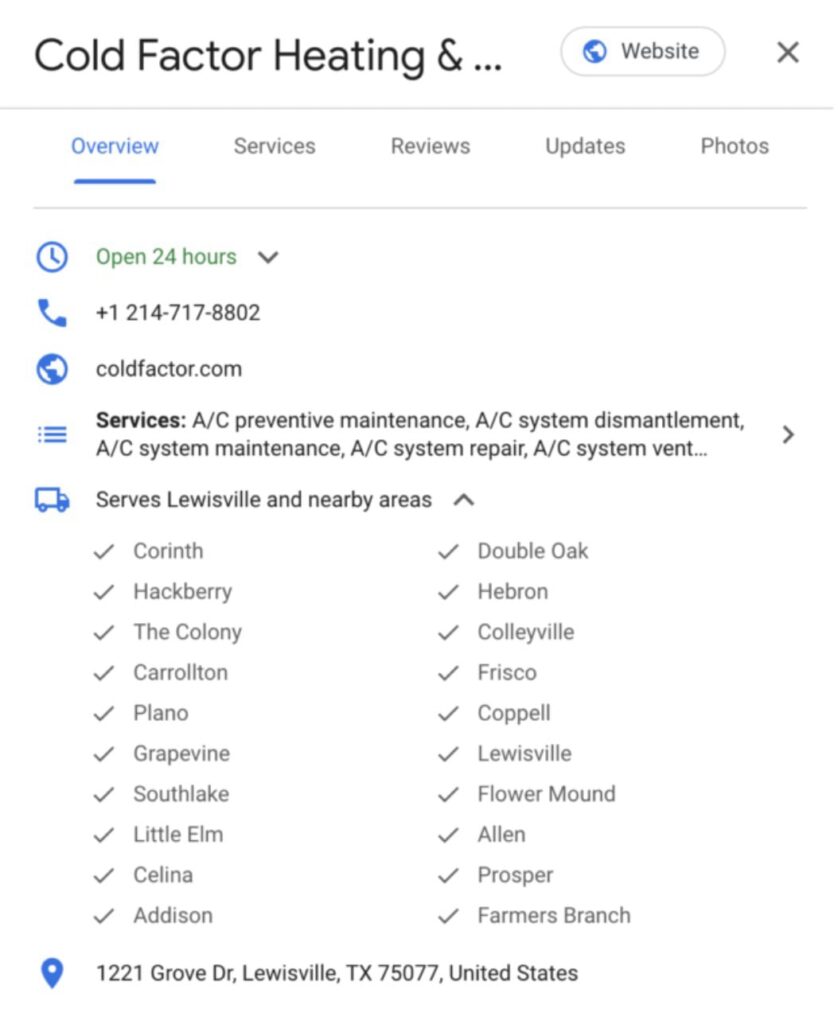
Your Google Business Profile (also known as Google My Business) is the most critical tool for local SEO, and it’s free. This listing appears in Google Maps and the local map pack. Setting it up right leads directly to phone calls.
Claim and verify your profile, then complete every field with precision. Fill out exact business hours, define all services you offer, and list every town and zip code you serve. Upload real photographs—your branded trucks, technicians in uniform, and before-and-after shots. Avoid stock photos.
Post weekly updates about seasonal specials, maintenance tips, or new hires. Seed the Questions & Answers section with common queries like “Do you offer financing?” Most importantly, respond to every review—both positive reviews and negative ones.
Citations and Local Directories
Citations are when websites list your business name, address, and phone number (NAP). Google uses these to verify your business is legitimate. The basic rule: keep your NAP exactly the same everywhere. Even slight variations like “St.” instead of “Street” hurt your authority.
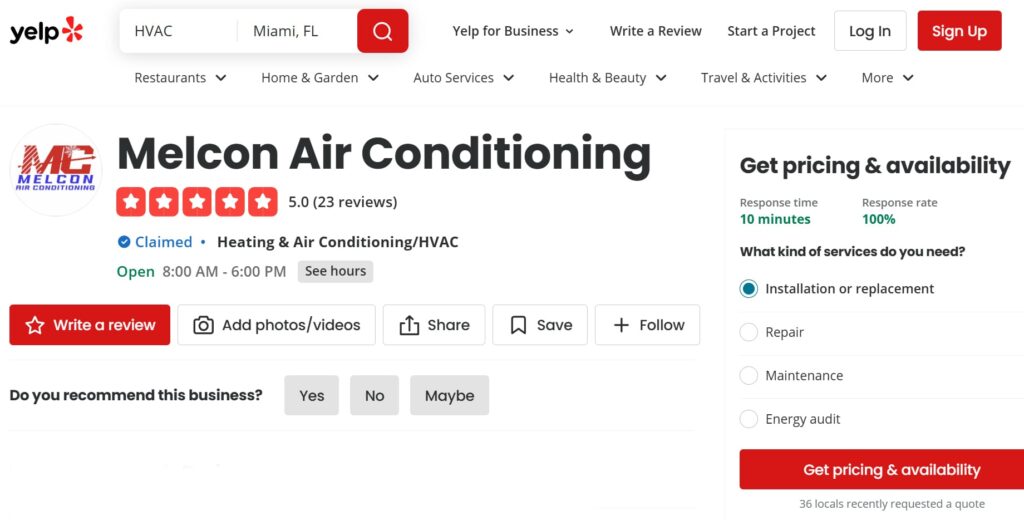
Make sure your business listings are correct on Yelp and the Better Business Bureau (BBB). These high-authority sites build trust with customers and search engines. Beyond major platforms, seek industry-specific listings. Your local Chamber of Commerce or community business associations send powerful signals of local relevance to Google.
Check all websites that mention your HVAC business and correct inconsistencies. Cleaning up messy NAP information often delivers significant boosts to local search rankings.
Local Content Strategy
A local content strategy proves you’re the authority in your area. Create website content hyper-relevant to the specific communities you serve. Stop thinking about your service area as one big region—target it neighborhood by neighborhood.
Create dedicated pages for each primary city or town. A page for “HVAC Repair in Tampa” and another for “Furnace Installation in St. Petersburg” help you rank for location-specific searches. Include unique content mentioning local landmarks, common housing types, and testimonials from that community.
Feature local case studies. “High-Efficiency AC Installation in a South Tampa Bungalow” demonstrates expertise and helps potential customers see themselves in your work. Connect content to local conditions: “Preparing Your Florida HVAC System for Summer Heat Waves” or “Tips for Dealing with High Humidity.” This proves you don’t just serve the area—you’re part of it.
User Experience Signals
Google rewards websites that provide a good user experience. For HVAC, where users are often in emergency mode, a frictionless experience is critical.
Your contact number should be visible on every page and click-to-call on mobile. Your site must load quickly—slow times hurt search rankings. It needs a mobile-friendly design, since most emergency HVAC searches are done on smartphones. Ensure simple, intuitive navigation. A homeowner with a broken AC won’t tolerate confusing menus.
The Technical Stuff That Makes or Breaks You
Technical SEO ensures search engines can properly crawl, index, and understand your website. Without a solid technical foundation, it undermines all your on-page and local SEO work. A technically sound website signals professionalism to Google.
Make Your Site Load Fast
Slow websites lose customers and tank your rankings. Someone with a broken AC in July isn’t waiting around for your site to load—they’re calling whoever shows up first. Your pages need to load in under three seconds. Test yours with Google’s PageSpeed Insights. Usually, the problem is huge image files, crappy hosting, or too many plugins slowing everything down.

On-Page SEO for HVAC Websites
Every page on your site needs to work for both Google and your customers. That means getting your page titles right, organizing content with proper headings, optimizing images, and adding the technical stuff like meta descriptions and schema markup. Get this right and your site will actually bring you customers.
Pages Your HVAC Site Must Have
Here’s what every HVAC site needs:
- Homepage: Tell people what you do, list your main services, and make it stupid-easy to call you.
- Individual Service Pages: One page per service—furnace repair gets its own page, AC installation gets its own page. This helps you rank for specific searches.
- Service Area Pages: Separate pages for each city or neighborhood you serve. Google needs to see that you’re actually local.
- About Page: Show real photos of your team, your licenses, certifications, and insurance info. Prove you’re legit.
- Contact Page: Phone number, contact form, click-to-call button, and Google Map showing where you’re located.
How to Write Title Tags and Meta Descriptions
When you show up in Google, people see two things: your title tag and meta description. Write these right, and people will click on you instead of your competitor.
- Title Tags: This is your most important on-page SEO element. Format: [Primary Service] in [City] | [Your Company Name]. Stay under 60 characters or Google cuts it off.
- Meta Descriptions: Write a 150-160 character summary that makes people want to click. Include your main keyword, end with a call-to-action like “Call today for a free estimate.”
Content Structure
- Headings: One H1 per page with your main keyword. Then use H2s and H3s to organize everything else. Don’t skip levels—don’t go from H2 to H4.
- Readability: Short paragraphs—3-4 sentences max. Use bullet points to break up walls of text and make it easy to scan.
Mobile Optimization
Google uses mobile-first indexing, which means it judges your entire website based on its mobile version. This is non-negotiable for HVAC contractors, since most emergency searches are done on smartphones. Use Google’s Mobile-Friendly Test tool. Ensure the click-to-call button is prominent, text is readable without zooming, and buttons are thumb-friendly.
Schema Markup: Why You Need It
Schema markup is code you add to your website, so Google knows exactly what your business does. This is what puts star ratings in your search results and makes your listing stand out. Your web developer can add it, or use an SEO plugin if you’re on WordPress. Here’s what you need:
LocalBusiness Schema: Tells Google your business name, address, phone number, and hours.
- LocalBusiness Schema: Reinforces company name, address, phone number, and hours.
- Service Schema: Defines each HVAC service you offer.
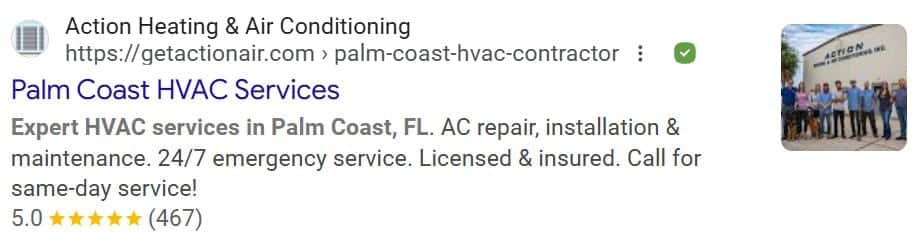
- Review Schema: Allows star ratings to appear in search results, building instant trust.
FAQ Schema: Makes Q&A content eligible to appear in search results.
Crawlability and Indexing
Google can’t rank pages it can’t find. Upload an XML sitemap to Search Console—this shows Google which pages matter on your site. Then check your robots.txt file and make sure you’re not accidentally blocking Google from reading important stuff. Fix broken links when you find them (those 404 error pages). Use Search Console to catch these problems before they hurt your rankings.
Keep Leads Coming All Year Long
Most HVAC companies get slammed in summer and winter, then starve in spring and fall. Smart content fixes that. Publish the right articles 4-6 weeks before people start searching for them, and you’ll have leads coming in every single month. No more feast-or-famine.
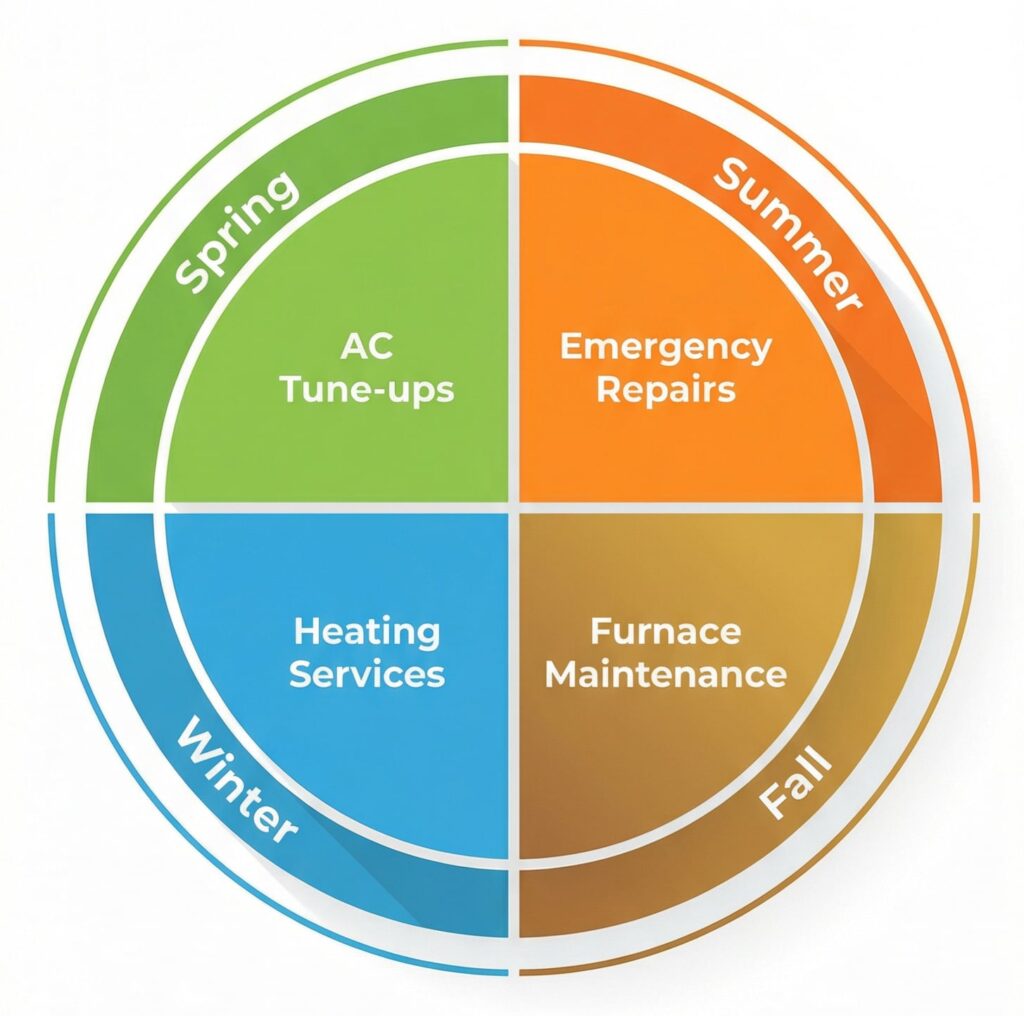
Seasonal Content Calendar
Publish content 4-6 weeks before customers start searching. Content needs time to get indexed and start ranking.
- Spring (Publish March-May): AC tune-ups, system preparation guides, and indoor air quality for allergy season.
- Summer (Publish June-August): Emergency repair content, energy efficiency tips, AC replacement warning signs.
- Fall (Publish September-November): Furnace maintenance guides, winterizing checklists, pre-season heating check-ups.
Winter (Publish December-February): Emergency furnace repair, indoor air quality when windows are closed, furnace failure signs.
Evergreen vs. Seasonal Content
You need both types of content. Evergreen content works year-round—stuff like “How much does HVAC maintenance cost?” stays relevant forever. Seasonal content targets specific times when search volume explodes—like “AC not cooling” in July.
- Evergreen Content (70%): Core service pages and fundamental questions like “How much does HVAC maintenance cost?” or “How often should I change my air filter?”
- Seasonal Content (30%): Timely, location-specific content addressing weather-driven needs like “Preparing Your Tampa Home for Hurricane Season” or “Winter Heating Tips for Florida Snowbirds.”
Content Types That Convert
Focus on formats designed to convert visitors into paying customers:
- Service Pages: Primary conversion pages—one dedicated page per service.
- FAQ Pages: Capture high-intent, long-tail searches answering “how much,” “how long,” and “what does” queries.
- How-To Guides: Build trust by demonstrating expertise on topics customers care about.
- Local Guides: Prove local authority with “HVAC Considerations for Florida Humidity” or “Proper AC Sizing for Tampa Homes.”
- Comparison Content: Help decisions with “Heat Pump vs. Traditional AC in Florida Climate.”
Every piece should answer a real customer question. Ask your technicians what customers ask on service calls—their insights are your most valuable source of content ideas.
Building Backlinks for HVAC
Backlinks from other websites remain one of Google’s strongest ranking signals. For HVAC companies, the goal isn’t thousands of links—it’s earning relevant, local links signaling authority in your service area. Each quality backlink tells Google your HVAC business is legitimate and trusted. Focus on acquiring links that build real-world authority.
Local Link Building Strategies
Most valuable links come from sources within your service area:
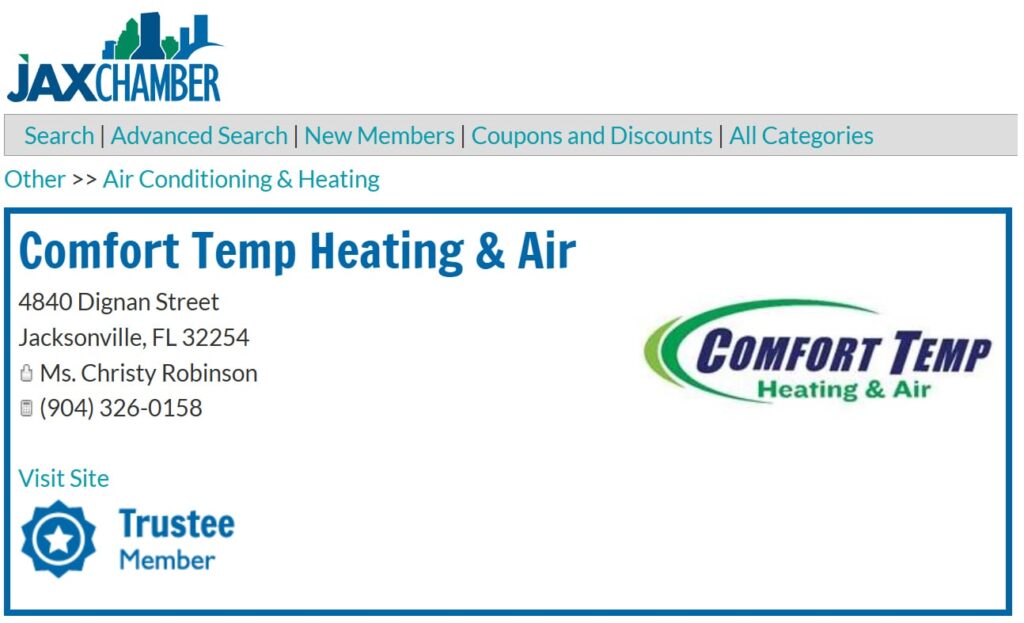
- Join your local Chamber of Commerce for citation links.
- Sponsor local teams, school fundraisers, or charity events. Organizations list sponsors with links.
- Build partnerships with plumbers, electricians, real estate agents, and property managers who can refer business and link to you.
- Earn listings in local “best of” awards and industry sites.
- When local news covers heat waves, cold snaps, or energy costs, reach out and offer yourself as an expert source. Local reporters need quotes, and you get a backlink.
Industry and Supplier Links
HVAC industry connections provide authoritative links reinforcing expertise:
- Pursue manufacturer certifications. Brands like Trane, Carrier, and Lennox feature certified dealers in searchable online databases.
- Join prominent HVAC industry associations listing members.
- Leverage supplier partnerships. Many distributors feature “authorized dealer” pages linking to companies they work with.
- Ensure NATE, EPA, and professional certifications are listed in searchable public databases.
What to Avoid
Wrong tactics risk Google penalties, erasing your visibility:
- Never buy links—direct violation of Google’s guidelines.
- Avoid link farms and private blog networks (PBNs) designed to manipulate search rankings.
- Don’t submit to thousands of irrelevant, low-quality listing sites.
- Avoid aggressive reciprocal linking schemes at scale.
One link from your local newspaper or Chamber of Commerce beats 100 links from random directories Google doesn’t care about. And yes, social media links don’t help your rankings directly, but being active on social media gets people talking about you—which leads to real backlinks.
Measuring HVAC SEO Success
Track the numbers that actually bring you business, not just traffic stats that look impressive. Here’s what matters:
Essential Tools for Tracking
Google gives you everything you need for free:
- Search Console: Shows which searches bring people to your site, any problems Google’s having with your pages, and how your site works on mobile.
- Google Analytics (GA4): Shows what visitors do on your site, where they came from, and whether they fill out your contact form.
- Google Business Profile Insights: Shows how people use your listing—how many call you, ask for directions, or click to your website.
Call Tracking Software (Optional): Gives you different phone numbers for different marketing channels so you know which leads came from SEO.
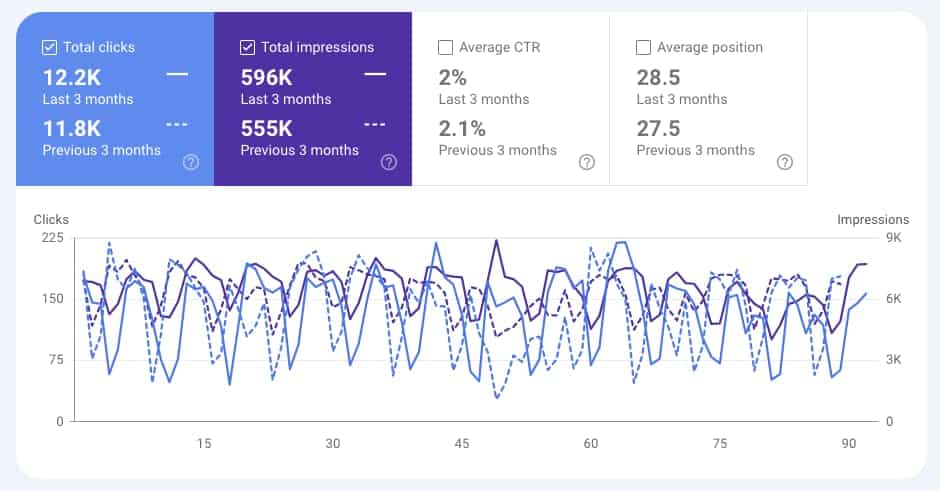
What to Actually Track”
Watch these numbers:
- Organic Traffic: More people finding you through Google searches (not ads).
- Keyword Rankings: Where you show up for searches like “HVAC repair in [Your City].”
- Click-Through Rate (CTR): How many people who see you in search results actually click on your listing.
- Conversions: Phone calls and contact form submissions from organic traffic.
- Google Business Profile Actions: More calls, direction requests, and website clicks from your listing.
- Local Pack Visibility: How often you show up in the top three map results.
Setting Realistic Expectations
SEO takes time. Anyone promising page-one rankings in 30 days is either lying or using tactics that’ll get you penalized.
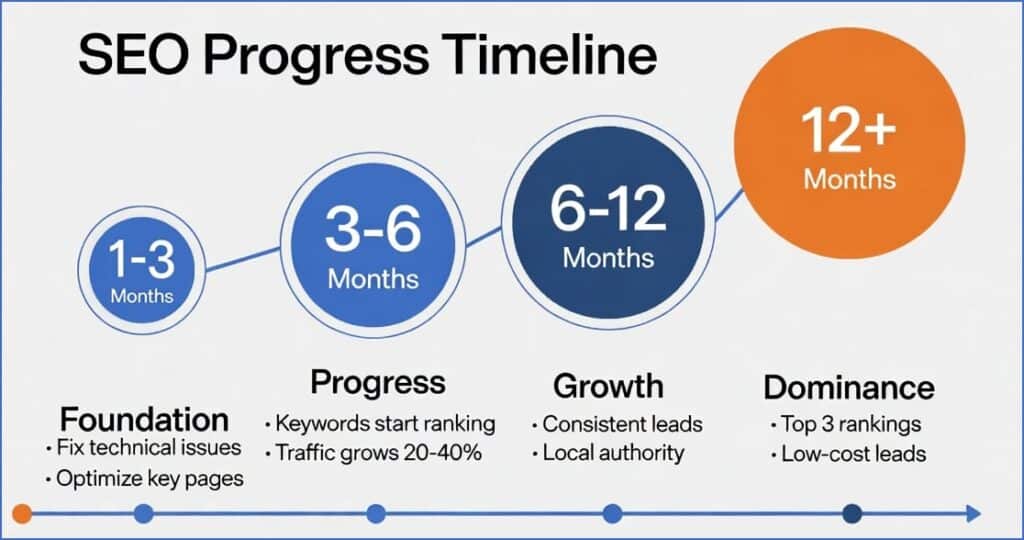
- Months 1-3: Fix technical problems, optimize your pages, start creating content. Google needs time to notice your changes. Don’t expect much movement yet—you’re building the foundation.
- Months 3-6: Now you’ll see progress. Rankings climb for specific search terms, traffic jumps 20-40%, and you start getting actual leads from Google.
- Months 6-12: Things really pick up. Rankings hold steady for tougher keywords, leads come in regularly, and Google starts seeing you as the local authority.
Month 12+: Keep at it and you dominate your market. You own the top spots for valuable search terms, leads from SEO cost way less than paid ads, and your competition can’t catch up without putting in the same year of work you did.
You might not need an agency. Some SEO tasks are simple enough to handle yourself. Others? You’ll waste months trying to figure them out. It depends on how competitive your market is, how much time you actually have, your budget, and how bad your current website situation is.
What You Can Handle In-House
You can handle these basics yourself and make real progress:
- Business Profile Management: Post updates, upload real photos, respond to every review, and maintain social media presence.
- Basic Content Creation: Write blog posts answering common customer questions.
- Review Management: Request reviews from happy customers, engage with all feedback.
- Basic Website Updates: Update text and images if using a simple CMS.
- Monitoring Search Console: Watch for obvious errors or performance drops.
When to Bring in a Professional
Hire experts for the stuff that can wreck your site if done wrong:
- Technical SEO Audits: Diagnose and fix site speed, schema markup, and crawlability issues.
- Competitive Analysis: In-depth keyword research and competitor strategy analysis.
- Link Building Strategy: Building high-quality, relevant links is difficult. Doing it wrong risks penalties.
- Website Redesigns: Mishandling migrations destroys years of SEO progress.
- Penalty Recovery: Need an expert to diagnose the cause and execute recovery.
- Scaling Content: Scale production without sacrificing the quality needed to rank.
Red Flags When Hiring
Watch for these red flags:
- Guarantees of #1 rankings or specific timeframes—no one can guarantee rankings.
- Lack of transparency—if they won’t explain methods or share reports, they’re hiding something.
- Long contracts without performance clauses.
- Vague language like “proprietary techniques.”
- Prices too good to be true—quality SEO requires significant time and expertise.
- Inability to provide case studies or references from similar businesses.
Questions to Ask Before Hiring
Make smart hiring decisions with direct questions:
- Can you show specific results for other HVAC or home service companies?
- What specific tactics will you use, and how do they align with Google’s guidelines?
- What metrics do you track, and how often will we review progress?
- Do I retain ownership of all content and technical improvements if we part ways?
- How do you measure success beyond rankings to show real business impact?
The best agencies act as partners, educating you about digital marketing. If an agency wants to keep you in the dark, find a different partner.
HVAC SEO Checklist
Use this checklist to audit current efforts or guide your strategy from scratch:
Google Business Profile
- Profile claimed and verified
- All information is complete and accurate
- Real photos uploaded (team, trucks, completed work)
- Posting updates weekly
- Responding to all reviews
Website Foundations
- Mobile-friendly design
- Page load time under 3 seconds
- Dedicated page for each service
- Service area pages for key locations
- Clear contact information on every page
- Internal linking between related pages
Content
- Seasonal content calendar planned
- FAQ page answering common questions
- Blog posts targeting customer questions
Local SEO
- NAP is consistent across all listings
- Listed on major platforms (Yelp, BBB)
- Local citations from community organizations
Tracking
- Google Search Console set up
- Google Analytics (GA4) installed
- Call tracking in place (optional but recommended)
Frequently Asked Questions
How Long Does HVAC SEO Take to Work?
Expect measurable results within 3-6 months. Significant, consistent lead flow typically begins between months 6 and 12. Unlike paid advertising, SEO compounds—work done today builds authority, paying dividends for years. Be wary of agencies promising page-one rankings in 30 days.
How Much Does HVAC SEO Cost?
Cost varies based on goals and market. Handle basics yourself for just your time. Professional agency services typically range from $1,500 to $5,000+ per month, depending on competitiveness, the current state of the website, and scope. Quality SEO requires real expertise and hours of work. Focus on ROI—what’s the lifetime value of one new installation customer?
Can I Do SEO Myself?
You can handle the basics: keep your Google Business Profile up to date, write blog posts that answer customer questions, and ask happy customers for reviews. That stuff’s not hard once you know what to do.
But technical SEO, site speed optimization, and link building? That’s where most business owners mess things up and waste months fixing avoidable problems. Here’s what works: you handle the day-to-day stuff, hire experts for the technical work that actually moves the needle.
“You’ll be surprised at how many Google Business Profiles we find are incorrect due to well-meaning local business owners managing their GBPs themselves. Nine out of ten local clients we audit are doing it incorrectly.” – Gary Honold
What’s More Important—SEO or Paid Ads?
They’re not mutually exclusive; best strategies use both. Paid ads deliver immediate visibility and leads, but stop when you stop paying. SEO starts slower but builds sustainable, long-term authority, generating leads without ongoing ad spend. Use paid ads for immediate lead flow while investing in SEO as your long-term growth engine. For most HVAC companies, SEO delivers better return on investment over time.
You now have a complete roadmap for HVAC SEO in 2026. This guide contains everything you need to start claiming your share of local search traffic, building authority, and generating consistent lead flow.
SEO rewards consistency over perfection. The most important step is the first one. Follow this guide to build a powerful digital foundation piece by piece. If you want to accelerate growth and focus on what you do best, our team can implement this strategy for you.
Either way, the plan works. Now it’s time to put it into action. Schedule a free strategy session to see exactly where you’re visible and where you’re losing customers.
Reviews